The EUR/USD pair unexpectedly plunged on Friday, wiping out the bulls' efforts earlier in the week. Over the past several weeks, the euro has traded near its lowest levels
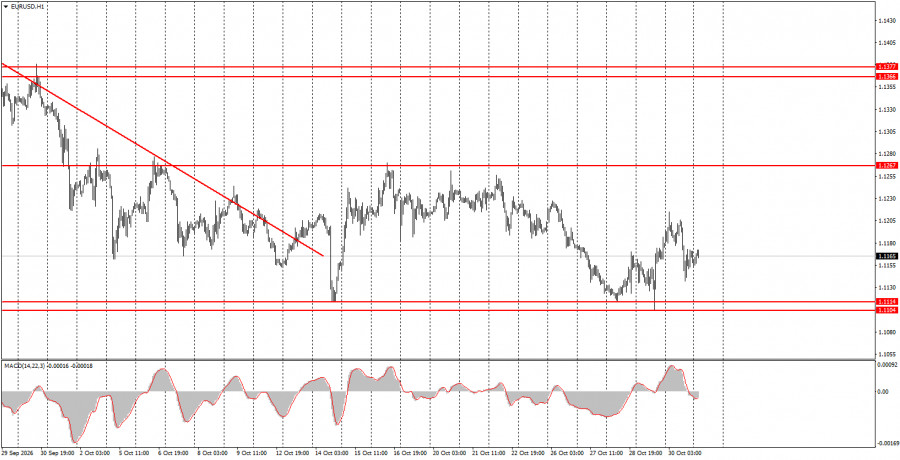
The EUR/USD pair unexpectedly plunged on Friday, wiping out the bulls' efforts earlier in the week. Over the past several weeks, the euro has traded near its lowest levels in about 18 months and has struggled to find a market floor. We continue to view the recent euro decline as illogical and unfounded — it should have ended already, and the market should recall that inflation is rising not only in the U.S. and that monetary tightening is not confined to the Federal Reserve. Yet on Friday the market seemed to forget this again. In practice, one German inflation report was enough to send the euro sharply lower. In contrast, fairly positive GDP prints for Germany and the euro area were ignored—classic behavior in the past two months. So on Monday the euro remains, first, at the bottom and, second, inside the broad range that has formed over recent weeks between roughly 1.1114 and 1.1267. That range is wide on the hourly chart, but it's better for the euro than a renewed, deeper drop.
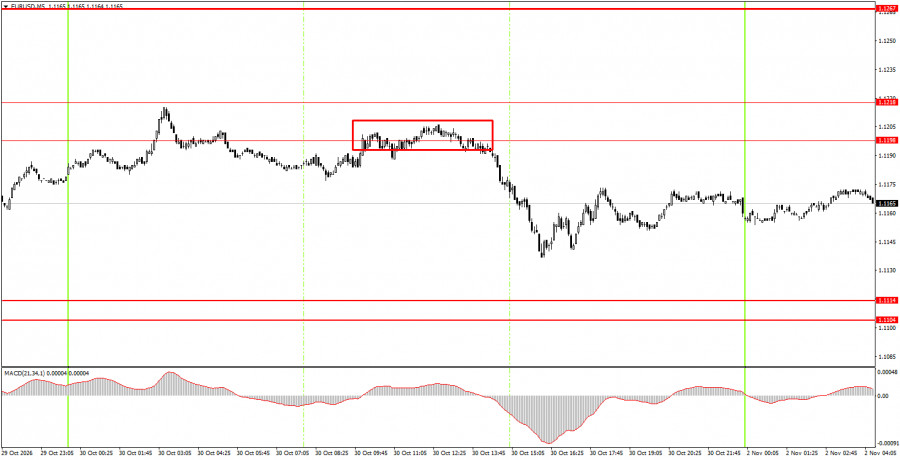
On the 5-minute timeframe, one sell signal formed on Friday, which novice traders could have easily traded for a profit. During the European session, the pair bounced from the resistance area 1.1198–1.1218, and by the end of the day the price fell roughly 30 pips.
On the hourly timeframe, EUR/USD retains a downward tendency that is a full-fledged trend but has moved into a sideways mode. The euro has not staged a proper correction in recent weeks, though the chances of an eventual uptrend remain. Considering recent months' events, we do not think the euro should have fallen like a stone. The dollar is heavily overbought, and many euro-bullish factors continue to be ignored.
On Monday, novice traders can open short positions on a fresh bounce from the 1.1198–1.1218 area, targeting 1.1104–1.1114. Place long positions on a confirmed close above the 1.1198–1.1218 area, targeting 1.1267–1.1275.
On the 5-minute TF consider trading the levels 1.1011, 1.1104–1.1114, 1.1198–1.1218, 1.1267–1.1275, 1.1366–1.1377, 1.1461–1.1474, 1.1527–1.1531, 1.1584–1.1594, 1.1655–1.1665. On Monday, the only notable release is the U.S. ISM manufacturing index; other publications are secondary.
Price levels (areas) of support and resistance — levels that serve as targets when opening longs or shorts or as sources of signals.
Red lines — channels or trendlines that display the current trend and indicate the preferred trading direction.
MACD indicator (14,22,3) — histogram and signal line — an auxiliary indicator that can also be used as a source of signals.
Important speeches and reports (listed in the news calendar) can strongly affect a currency pair's movement. Therefore, when they are released, one should trade as cautiously as possible or step aside to avoid a sudden price reversal against the prior direction.
Beginner forex traders should remember that not every trade can be profitable. Developing a clear strategy and money-management rules is the key to long-term success in trading.

LINKS RÁPIDOS
ForexMart is authorized and regulated in various jurisdictions.
(Reg No.23071, IBC 2015) with a registered office at First Floor, SVG Teachers Co-operative Credit Union Limited Uptown Building, Corner of James and Middle Street, Kingstown, Saint Vincent and the Grenadines
Restricted Regions: the United States of America, North Korea, Sudan, Syria and some other regions.


 Contate-nos