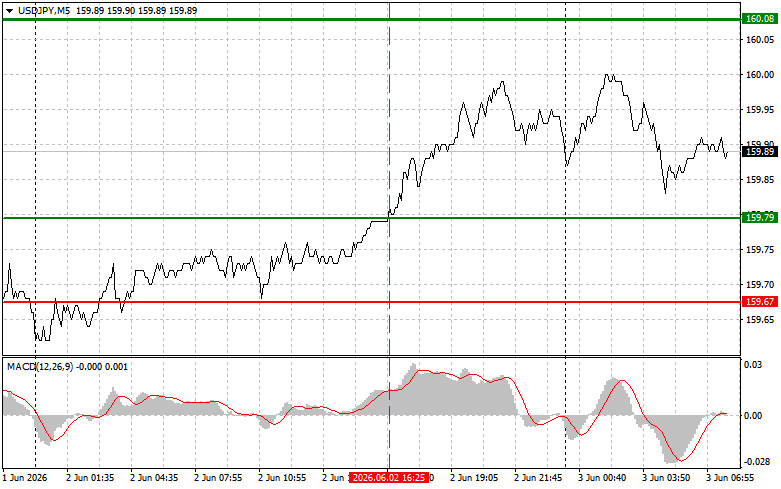
The test of the price level at 159.79 occurred when the MACD indicator had moved significantly above the zero mark, which limited the pair's upward potential. For this reason, I did not buy the dollar.
Yesterday's news that Iran has suspended negotiations with the US due to breaches of the ceasefire led to a rise in the US dollar. Markets, spooked by another escalation of regional tensions, sought refuge in traditionally safer assets, and the dollar once again led the move.
Today, financial markets eagerly await the speech from the Governor of the Bank of Japan, Kazuo Ueda. This event could be a key moment that significantly impacts the future direction of the country's monetary policy, particularly regarding interest rates. Analysts worldwide are closely monitoring every word to predict what steps the Bank of Japan will take in light of current economic trends.
The last few months have been marked by uncertainty about inflation indicators and economic growth in Japan. Governor Ueda, known for his cautious approach, is likely to present a balanced assessment of the situation, considering both domestic and global factors. Special attention will be given to whether he provides clear signals about the possibility of further monetary policy tightening, as the yen has been in need of strengthening, and recent interventions have not yielded noticeable results.
Regarding the intraday strategy, I will focus more on implementing scenarios #1 and #2.
Scenario #1: I plan to buy USD/JPY today when the price reaches around 159.98 (the green line on the chart), targeting a rise to 160.35 (the thicker green line on the chart). At 160.35, I intend to exit my positions and sell back in the opposite direction (expecting a move of 30-35 pips from that level). It's best to return to buying the pair during corrections and significant pullbacks in USD/JPY. Important! Before buying, ensure the MACD indicator is above the zero mark and just beginning to rise from it.
Scenario #2: I also plan to buy USD/JPY today in the event of two consecutive tests of the price 159.94 when the MACD indicator is in the oversold zone. This will limit the pair's downward potential and lead to a market reversal upwards. Growth can be expected towards the opposing levels of 159.98 and 160.35.
Scenario #1: I plan to sell USD/JPY today only after it breaks below 159.84 (red line on the chart), which will trigger a rapid decline in the pair. The key target for sellers will be the 159.49 level, where I intend to exit my short positions and immediately buy back in the opposite direction (expecting a move of 20-25 pips from that level). Sellers could return at any moment; any hint from the central bank could trigger this. Important! Before selling, ensure the MACD indicator is below the zero mark and just beginning to decline from it.
Scenario #2: I also plan to sell USD/JPY today in the event of two consecutive tests of the price 159.98 when the MACD indicator is in the overbought zone. This will limit the pair's upward potential and lead to a market reversal downwards. A decrease can be expected towards the opposing levels of 159.84 and 159.49.
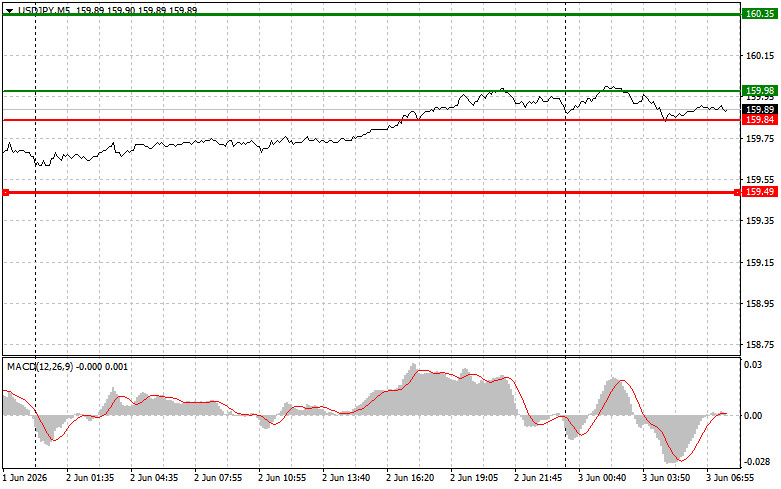
Thin green line – entry price for buying the trading instrument;
Thick green line – presumed price level for placing Take Profit or manually securing profits, as further growth above this level is unlikely;
Thin red line – entry price for selling the trading instrument;
Thick red line – presumed price level for placing Take Profit or manually securing profits, as further decline below this level is unlikely;
MACD Indicator. When entering the market, it is important to consider the overbought and oversold zones.
Important: Beginner traders in the Forex market must be very cautious when making entry decisions. Before major fundamental reports are released, it is best to stay out of the market to avoid being caught in sharp fluctuations. If you decide to trade during news releases, always set stop orders to minimize losses. Without setting stop orders, you can quickly lose your entire deposit, especially if you are not using money management and are trading large volumes.
And remember, for successful trading, you need a clear trading plan similar to the one presented above. Making spontaneous trading decisions based on the current market situation is inherently a losing strategy for intraday traders.

LINKS RÁPIDOS
ForexMart is authorized and regulated in various jurisdictions.
(Reg No.23071, IBC 2015) with a registered office at First Floor, SVG Teachers Co-operative Credit Union Limited Uptown Building, Corner of James and Middle Street, Kingstown, Saint Vincent and the Grenadines
Restricted Regions: the United States of America, North Korea, Sudan, Syria and some other regions.





 Contate-nos