Norimberk (Německo) – Německé pivovary ztrácejí pozice mezi největšími světovými producenty piva. Informovala o tom agentura DPA, která se odvolává na data největšího světového obchodníka s chmelem BarthHaas. Největších 40 pivovarů na světě loni vyrobilo téměř 164 miliard litrů piva, což představuje meziroční pokles o 0,6 procenta. V žebříčku se udrželo šest německých výrobců.
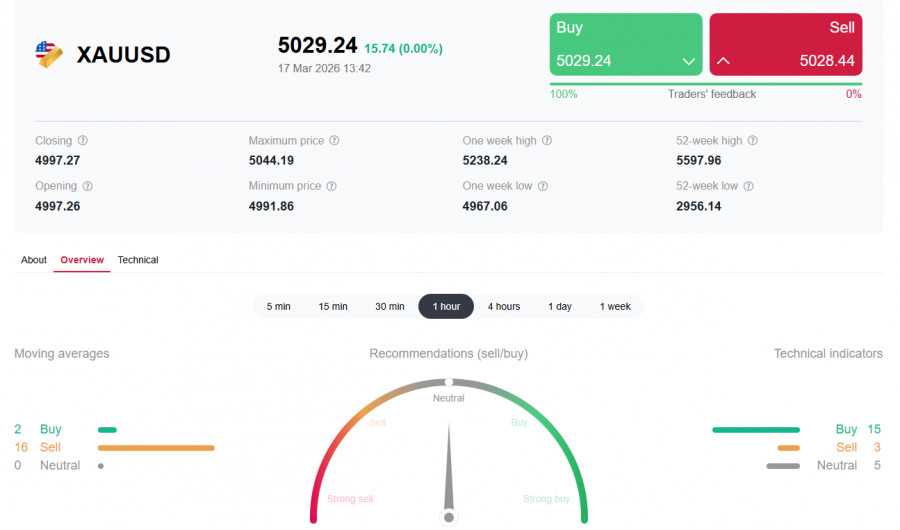
*see also: Trading indicators for XAU/USD
The market is on pause in anticipation of key events this week — meetings of major central banks that will define the future trajectory of monetary policy amid the oil shock and geopolitical uncertainty.
Meanwhile, gold continues to exhibit a dynamic that is mysterious to many investors: despite the weakening of the US dollar and the escalation of the Middle Eastern conflict, the precious metal remains in a narrow range around the psychologically important 5000.00 level.
The US dollar index USDX has corrected downward from the psychological level of 100.00.
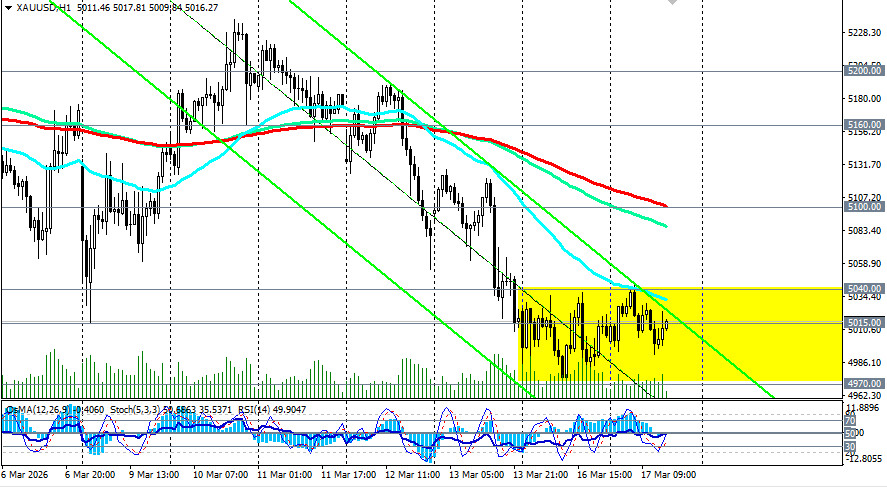
However, gold has not been able to capitalize on this classic opportunity for growth, remaining virtually unchanged. The metal's price is consolidating just above the 5000.00 level, fluctuating in the range of 4970.00–5040.00 after yesterday's fall to weekly lows.
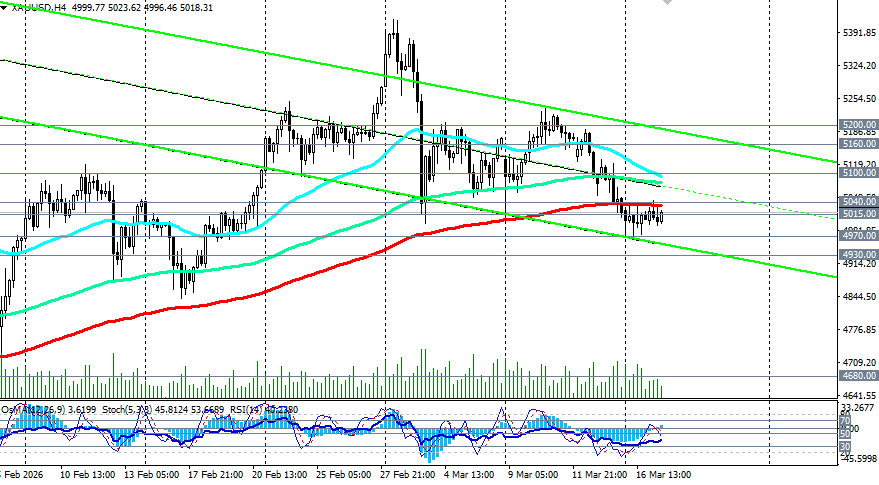
Technical picture on the 1-hour chart retains a bearish bias: the price remains below the 200-period EMA (5100.00) and 200-period EMA (5040.00) on the 4-hour chart, which serve as immediate and nearest resistance.
The main reason for the paradoxical behavior of gold is the fundamental revision of expectations regarding the Federal Reserve's monetary policy. Since the war in Iran began two and a half weeks ago, the price of gold has fallen by about 5%, while the US dollar has significantly strengthened. However, it is not just about the dollar.
By the end of last week, futures for Fed rates no longer priced in even a 25-basis-point cut by the end of the year. This means that nearly 50 basis points of expected rate cuts have been priced out of the market since the onset of the conflict. According to the CME FedWatch tool, the Fed is expected to stand pat in March, April, June, and July, with September seen as the nearest likely date for a rate cut, though the probability is around 40%.
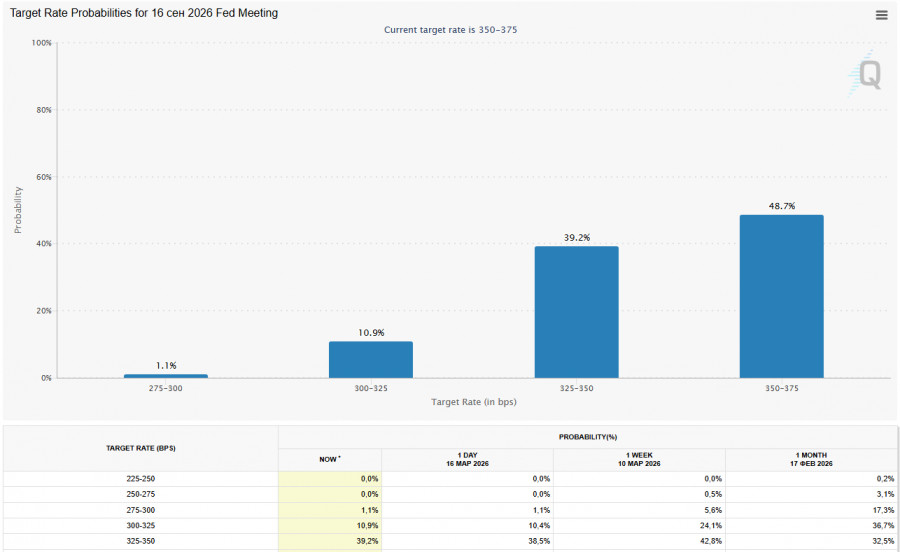
Pressure on gold, therefore, intensifies as expectations for a prompt rate cut in the US fade. Rising inflation risks associated with the escalation of the Middle Eastern conflict prompt the market to reassess its forecasts.
Oil prices have risen again after a temporary decline as investors assess the impacts of disruptions to energy supplies. Oil transit through the Strait of Hormuz, through which approximately 20% of global supplies pass, has nearly halted due to hostilities.
Tensions have intensified following Iran's attacks on targets in Persian Gulf countries, including vital energy facilities in the United Arab Emirates. US President Donald Trump has threatened to extend strikes against Iranian oil infrastructure and called on other nations to help ensure safety in the Strait.
Oil market analysts warn that a prolonged conflict could push oil prices to $100–120 per barrel, increasing inflationary pressure and slowing global economic growth. Rising energy prices hike transportation and production costs across the global economy, which in turn fuels inflation. Ironically, these inflationary risks lead the Fed to maintain a tight policy stance, which puts pressure on gold.
President Trump has called on other countries to help ensure security in the Strait of Hormuz, urging nations that rely on this route to support US efforts. However, international support remains limited:
Arsenio Dominguez, Secretary-General of the International Maritime Organization, stated that naval escort operations through the strait do not "guarantee 100 percent" safety for vessels, and military assistance is "not a long-term or sustainable solution."
This limited support reduces the geopolitical premium in gold prices, as the market does not see the prospects for a rapid escalation involving a global coalition.
Upcoming policy decisions from major central banks — the Fed, ECB, Bank of England, Bank of Japan, Bank of Canada, and Swiss National Bank — come at a particularly sensitive time for global markets.
Although all are expected to maintain interest rates at current levels, attention will focus on statements of intent and how policymakers assess future policy directions, given that high oil prices raise concerns about renewed inflationary pressure.
The FOMC meeting on Wednesday will be a key catalyst for gold. Markets expect the rate to remain at 3.75%, but the updated economic forecast (SEP), dot plot, and Jerome Powell's press conference will be closely analyzed for any shift in the rate trajectory. Higher real bond yields (TIPS) create opportunity costs for holding gold, which yields no interest income.
If the Fed signals "hawkish" tendencies, this will pressure gold through a stronger dollar and higher real yields, whereas any "dovish" hints could revive the rally.
The Bank of England is expected to maintain the rate at 3.75% at Thursday's meeting, pushing expectations for easing further out. The Bank of Japan, Bank of Canada, and other central banks will also assess the impact of the oil shock on inflation in their economies. The unanimity of central banks' caution creates a backdrop in which gold struggles to gain support.
The gold market is experiencing a unique moment in which classic support factors — a weakening dollar and geopolitical tensions — are offset by a radical reassessment of expectations for Fed monetary policy. Almost 50 basis points of expected rate cuts have been priced out of the market since the onset of the Iran war, fundamentally changing the situation for the non-yielding asset.
The key zone of 4970.00–5040.00 will become decisive in the coming days. The Fed meeting and Jerome Powell's rhetoric will determine whether gold can hold the psychological level of 5000.00 or resume its correction to 4930.00–4850.00. Any hints at maintaining a tight policy will send the metal to the lower boundary of the range, while cautiously "dovish" signals may trigger a rebound to 5160.00-5200.00 and above.
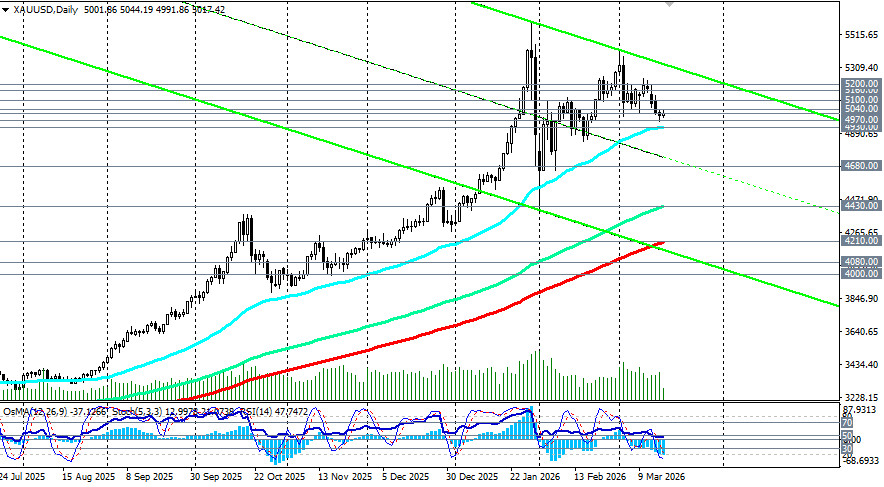
*For more details, see XAU/USD: scenarios for dynamics on 17.03.2026

LINKS RÁPIDOS
ForexMart is authorized and regulated in various jurisdictions.
(Reg No.23071, IBC 2015) with a registered office at First Floor, SVG Teachers Co-operative Credit Union Limited Uptown Building, Corner of James and Middle Street, Kingstown, Saint Vincent and the Grenadines
Restricted Regions: the United States of America, North Korea, Sudan, Syria and some other regions.





 Contate-nos