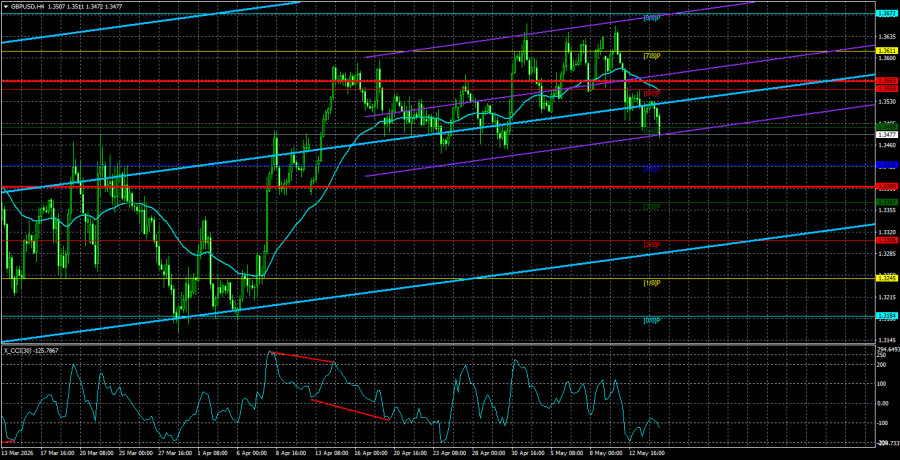
The GBP/USD currency pair traded much more calmly on Thursday than in the first days of the week, even avoiding a decline. Recall that this week, the market actively reacted to a new failure in negotiations between Iran and the US, Trump's words that "the ceasefire is hanging by a thread," another political crisis in the UK, and possibly the US inflation report. It is on the latter event that we will focus in this article.
We want to immediately note that macroeconomic data continue to be ignored by the market. There is currently no correlation between inflation and the Federal Reserve's interest rates. However, the market will not always ignore macroeconomics, and we do not yet know what the Fed's policy will be under the new head, Kevin Warsh. Yes, there is an opinion that Warsh will adhere to "dovish" views, as that was a key requirement from Trump for candidates for the position of Fed chair. But in reality, no one yet knows what Warsh will demand, whether he will insist on anything, or how Trump plans to influence the FOMC to conduct monetary easing through Warsh.
Thus, hypothetically, high inflation is the US dollar's main ally. The higher inflation, the greater the likelihood that the Fed will indeed have to raise rates in 2026. Consider this: in April, inflation jumped to 3.8%, up from 2.4% just two months ago. In just two months, inflation has nearly doubled. Meanwhile, the Strait of Hormuz remains blockaded, strategic reserves of oil and gas are depleting worldwide, and Donald Trump and the Iranian authorities have not even managed to negotiate an intermediate deal. Therefore, there are no chances for the reopening of the Strait in the near future. Consequently, the Strait will remain closed, the oil shortage will persist, and prices will likely continue to rise. Following this, inflation will increase as well.
Here, the Fed finds itself not merely in a trap but in a snare set by Trump. The American president, who has been demanding a cut in the key rate for a year and a half, is himself driving up inflation, making the reduction of the key rate virtually impossible. Moreover, to tame rising prices, the Fed must simply tighten policy. And most likely, this will need to happen multiple times. But how can Warsh support tighter policies when he enters the Fed with a "dovish mandate"? How can he advocate easing policy when such a stance amid rising inflation would cause laughter worldwide and, of course, be rejected by the majority of the Monetary Committee?
This situation is not even a "stalemate," but rather a "snare." Raising the rate is not an option, as the economy would slow down even further while Trump does everything to ensure it falls rather than grows. Lowering the rate is also not viable, because inflation could spike to double-digit levels. A "wonderful" position for the American central bank. By the way, the market still allows for the possibility that the Fed will raise rates once before the end of the year. However, it assumes that this will not happen before December. Therefore, until December, the Fed will have to watch with sad eyes as inflation rises, which took several years to control.
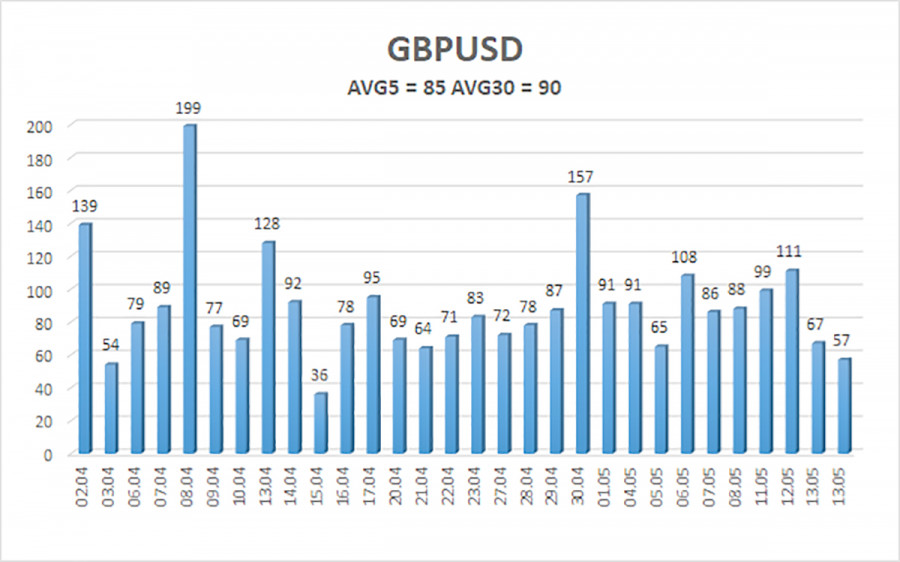
The average volatility of the GBP/USD pair over the last 5 trading days is 85 pips. For the pound/dollar pair, this value is considered "average." Therefore, on Friday, May 15, we expect movement within a range bounded by 1.3393 and 1.3563. The upper linear regression channel has turned upward, indicating a restoration of the upward trend. The CCI indicator has not generated signals lately.
S1 – 1.3428
S2 – 1.3367
S3 – 1.3306
R1 – 1.3489
R2 – 1.3550
R3 – 1.3611
The GBP/USD currency pair continues to recover after two "months of geopolitics." Trump's policies will continue to exert pressure on the US economy; therefore, we do not expect the US dollar to grow in 2026. Consequently, long positions with targets of 1.3916 and above remain relevant when the price is above the moving average. Conversely, if the price is below the moving average line, short positions with targets of 1.3428 and 1.3393 can be considered on technical grounds. In recent weeks, the British currency has recovered, and the geopolitical factor has continued to diminish its influence on the market.

SZYBKIE LINKI
ForexMart is authorized and regulated in various jurisdictions.
(Reg No.23071, IBC 2015) with a registered office at First Floor, SVG Teachers Co-operative Credit Union Limited Uptown Building, Corner of James and Middle Street, Kingstown, Saint Vincent and the Grenadines
Restricted Regions: the United States of America, North Korea, Sudan, Syria and some other regions.


 Skontaktuj się z ForexMart