Several macro releases are scheduled for Friday. Germany will publish important reports on unemployment, inflation, and Q3 GDP. The euro area will release its GDP and unemployment figures. The U.S
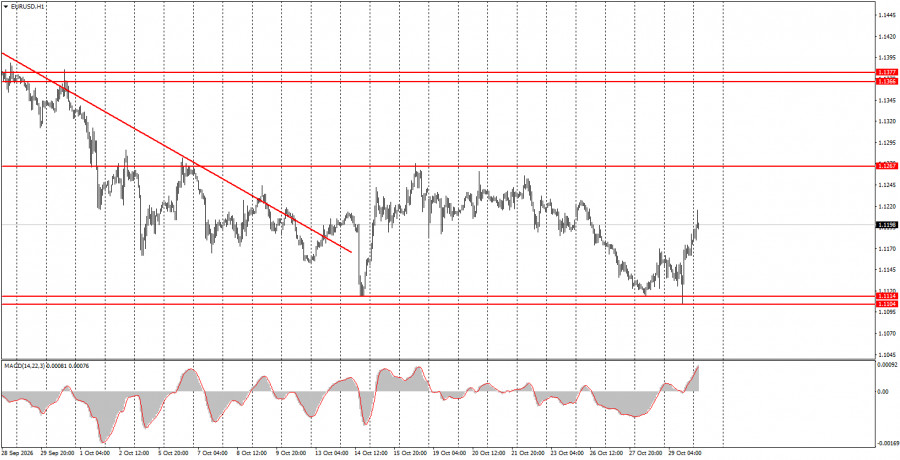
Several macro releases are scheduled for Friday. Germany will publish important reports on unemployment, inflation, and Q3 GDP. The euro area will release its GDP and unemployment figures. The U.S. and U.K. calendars are essentially empty. We do not expect European reports to trigger a major market reaction. Macro data are not the market's primary driver right now. Yesterday, U.S. GDP and inflation releases could have supported the dollar, yet the euro and the pound rose instead. The dollar remains overbought and arguably too strong — it should be vulnerable even across different macro scenarios.
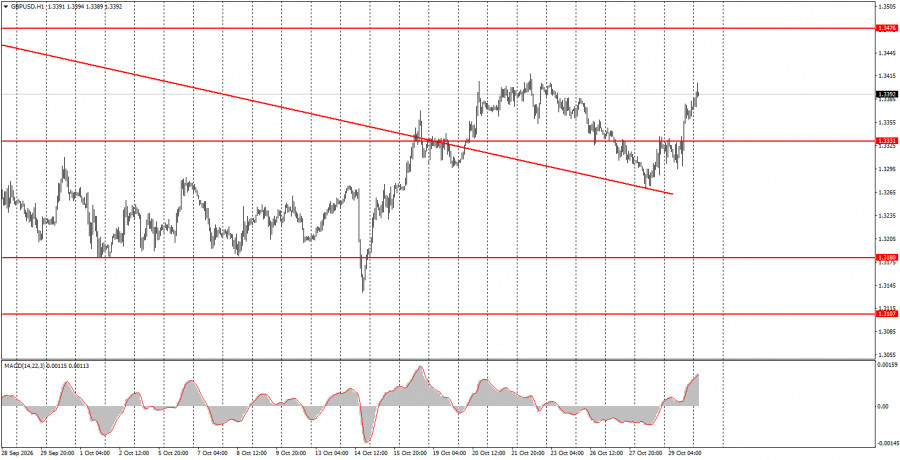
Among Thursday's fundamental events, European Central Bank chief economist Philip Lane will speak, but the ECB met only yesterday, and traders already know the bank's policy path. So we do not expect any major new announcements from Lane. It is clear the ECB will continue tightening in response to rising euro-area inflation, just as the Federal Reserve has been doing. It is also clear the market has not yet fully priced in ECB tightening.
The geopolitical backdrop remains poor. The U.S. and Iran are not in formal talks, and Donald Trump keeps saying a deal with Tehran could be reached — the question is when. Reports also suggest the U.S. and Israel could resume strikes on Iran after the U.S. midterms if no agreement is reached; we view that scenario as more likely than a ceasefire. Iran, for its part, is ready to resume strikes on U.S. allies in the region. In addition, mass unrest continues in several European countries, which is not supportive of the euro.
Volatility may be elevated on the final trading day of the week because of euro-area macro releases. We expect the euro and the pound to continue their recent strength. Trade EUR/USD from the 1.1198–1.1218 area and GBP/USD from the 1.3380–1.3386 area.
Price levels (areas) of support and resistance serve as targets for opening buy or sell trades or as sources of signals.
Red lines indicate channels or trend lines that show the current trend and the preferred trading direction.
The MACD indicator (14,22,3) — the histogram and signal line — is an auxiliary indicator that can also provide signals.
Important speeches and reports (listed in the news calendar) can significantly influence currency pair movements. Therefore, during their release, traders should approach trading with utmost caution, or exit the market to avoid sudden reversals against the preceding move.
Beginner forex traders should remember that not every trade can be profitable. Developing a clear strategy and practicing money management are key to long-term success in trading.
ForexMart is authorized and regulated in various jurisdictions.
(Reg No.23071, IBC 2015) with a registered office at First Floor, SVG Teachers Co-operative Credit Union Limited Uptown Building, Corner of James and Middle Street, Kingstown, Saint Vincent and the Grenadines
Restricted Regions: the United States of America, North Korea, Sudan, Syria and some other regions.


 コンタクトする