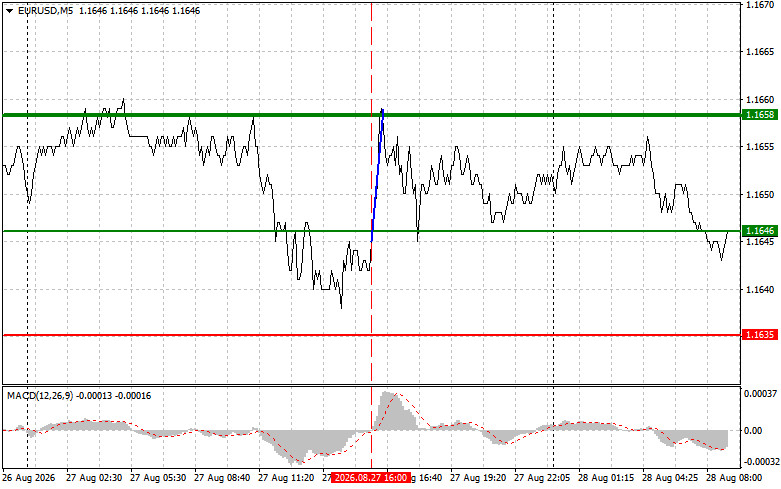
The price test at 1.1646 coincided with the moment when the MACD indicator was starting to move up from the zero mark, confirming the correct entry point for buying the euro. As a result, the pair rose towards the target level of 1.1658.
Data from the U.S. prompted a slight decline in the dollar ahead of Kevin Warsh's key speech. The labor market remained strong, as initial jobless claims fell to 203,000, and the four-week average remains significantly below last year's levels. Such data usually support the U.S. dollar, as stable employment gives the Federal Reserve the flexibility to maintain a hawkish stance. However, the external trade report spoiled the picture. The goods deficit surged to $118.8 billion, up 17.2%, against a backdrop of falling exports and rising imports, while inventories continued to build, with wholesale inventories increasing by 5.7% over the year.
The single currency took advantage of the dollar's subdued weakness and rose slightly. Concerns about trade and inventories balanced the strength of the labor market, removing the dollar's support for growth.
Today, the euro enters the first half of the day with its sights set on a busy economic agenda, with unemployment data from Germany and inflation and GDP figures from France being released. Employment and economic growth indicators help assess economic resilience, while inflation is particularly important because it influences the European Central Bank rate trajectory. The market reacts primarily to deviations of actual figures from forecasts rather than to the absolute values themselves. The environment for the single currency is demanding. Only significantly strong data that exceed economists' expectations can strengthen its position, as only assuredly positive results will confirm economic resilience and ECB's hawkish expectations.
Regarding the intraday strategy, I will rely more on implementing Scenarios No. 1 and No. 2.
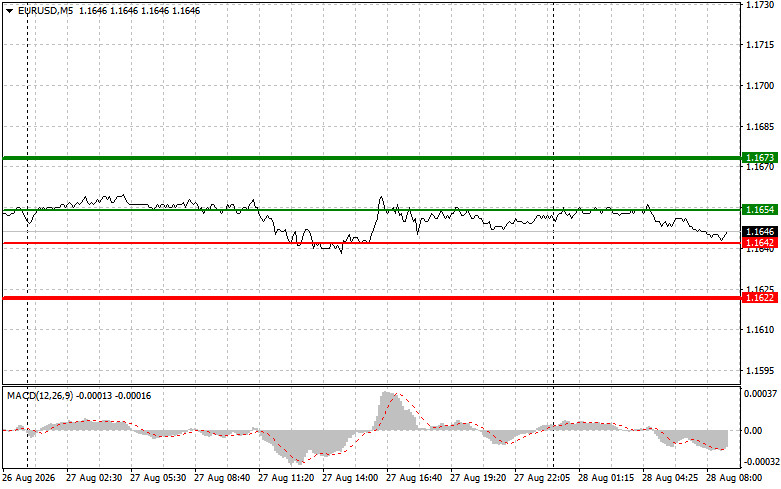
Scenario No. 1: Today, the euro can be bought when the price reaches around 1.1654 (the green line on the chart), with the aim of rising to 1.1673. At 1.1673, I plan to exit the market and also sell the euro in the opposite direction, anticipating a move of 30-35 pips from the entry point. One can expect the euro to rise only after very strong data. Important! Before buying, ensure that the MACD indicator is above the zero mark and is just beginning its upward movement from there.
Scenario No. 2: I also plan to buy the euro today in the event of two consecutive tests of 1.1642, with the MACD indicator in the oversold area. This will limit the downside potential of the pair and lead to an upward market reversal. One can expect a rise to the opposite levels of 1.1654 and 1.1673.
Scenario No. 1: I plan to sell the euro after the level of 1.1642 (the red line on the chart) is reached. The target will be 1.1622, where I plan to exit the market and immediately buy in the opposite direction (anticipating a move of 20-25 pips from that level). Pressure on the pair today will return with weak data. Important! Before selling, ensure that the MACD indicator is below the zero mark and is just beginning its downward movement from there.
Scenario No. 2: I also plan to sell the euro today in the event of two consecutive tests of 1.1654, with the MACD indicator in the overbought area. This will limit the upside potential of the pair and lead to a downward market reversal. One can expect a decline to the opposing levels of 1.1642 and 1.1622.
Important: Beginner forex traders need to make entry decisions very cautiously. Before key fundamental reports are released, it is best to stay out of the market to avoid sharp price fluctuations. If you decide to trade during news releases, always set stop orders to minimize losses. Without placing stop orders, you can quickly lose your entire deposit, especially if you do not practice money management and trade large volumes.
And remember, successful trading requires a clear trading plan, as outlined above. Making spontaneous trading decisions based on the current market situation is inherently a losing strategy for intraday traders.
ForexMart is authorized and regulated in various jurisdictions.
(Reg No.23071, IBC 2015) with a registered office at First Floor, SVG Teachers Co-operative Credit Union Limited Uptown Building, Corner of James and Middle Street, Kingstown, Saint Vincent and the Grenadines
Restricted Regions: the United States of America, North Korea, Sudan, Syria and some other regions.





 コンタクトする