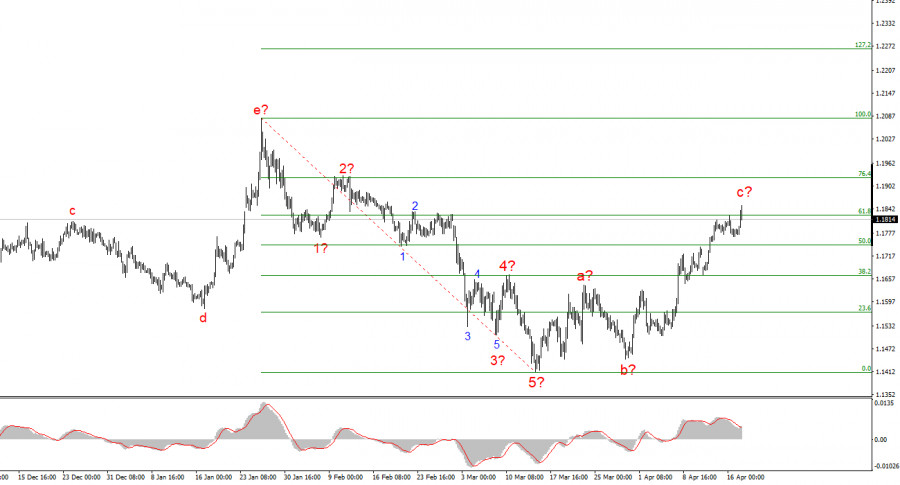
The wave structure on the 4-hour chart for EUR/USD has changed. There is still no question of canceling the upward trend segment (lower chart), which has been in place since January last year, but the structure now looks ambiguous. In such situations, it is better to switch to a lower timeframe (upper chart) and analyze simpler, smaller wave structures in order to make short-term forecasts, which are sufficient for opening trades. Wave structures can be very complex and allow for multiple scenarios. The simplest approach is to trade standard "five-three" patterns.
On the chart above, a classic five-wave impulse structure with an extended third wave can be identified. If this interpretation is correct, then the structure has been completed, and a corrective formation of at least three waves is now underway. Therefore, in the near term, price growth can be expected, but within a correction relative to the previous trend segment. The latest wave formations do not yet fully align with the higher-level structure, but this should become clearer over time. The recovery of the euro may end around the 1.1824 level.
The EUR/USD pair rose by 35 points on Friday. There was no major news during the day, and only in the evening did Iran's Foreign Ministry announce the reopening of the Strait of Hormuz. This topic will be discussed further in separate analyses, but for now we can assess the market reaction. Surprisingly, the reaction was fairly weak. Oil prices dropped sharply at first, as did demand for the safe-haven U.S. dollar. However, the dollar lost only about 50 points and recovered within a few hours. Meanwhile, the current wave structure still suggests the formation of at least one more downward wave.
Can we expect dollar strengthening next week given the reopening of the Strait of Hormuz? I believe we can—and here is why.
In recent weeks, the euro and the pound have been rising actively. This indicates that demand for the dollar has been declining, meaning the market was already pricing in a de-escalation scenario. Such a scenario implies not only a ceasefire in the Middle East (at least temporarily) but also the reopening of Hormuz. I admit that I did not expect the strait to reopen on Friday evening or even next week. However, at the beginning of the year, few anticipated a conflict in Iran either. Moreover, the second round of negotiations between Iran and the United States has not yet taken place, and no peace agreement has been signed. Therefore, the reopening of the Strait of Hormuz may be temporary. It will only be possible to speak about the final resolution of the conflict once Washington and Tehran agree on all key issues.
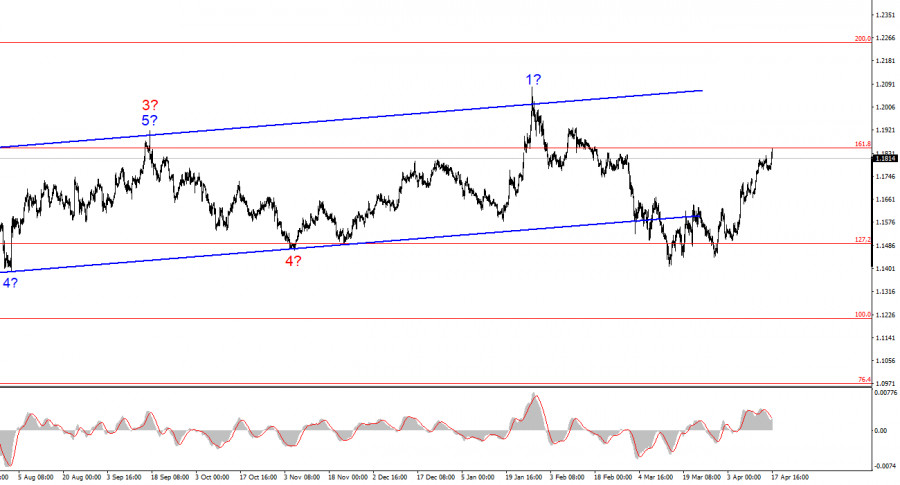
Based on this EUR/USD analysis, the instrument remains within an upward trend segment (lower chart) and, in the short term, within a corrective structure. The corrective wave formation appears largely complete and could become more extended and complex only if a stable and long-term ceasefire is established among Iran, the United States, Israel, and all other countries in the Middle East. Otherwise, a new downward wave sequence—or at least a corrective wave—may begin from current levels.
On a smaller timeframe, the entire upward trend segment is visible. The wave structure is not entirely typical, as corrective waves vary in size. For example, the higher-level wave 2 is smaller than the internal wave 2 within wave 3. However, such situations do occur. It is generally better to focus on clear and understandable structures rather than strictly adhering to every wave count. The trend may reverse in the near future.
Key Principles of My Analysis
ForexMart is authorized and regulated in various jurisdictions.
(Reg No.23071, IBC 2015) with a registered office at First Floor, SVG Teachers Co-operative Credit Union Limited Uptown Building, Corner of James and Middle Street, Kingstown, Saint Vincent and the Grenadines
Restricted Regions: the United States of America, North Korea, Sudan, Syria and some other regions.




 コンタクトする