The test of the 1.1195 price level occurred when the MACD indicator had just started moving upward from the zero line, confirming that it was the right point to enter
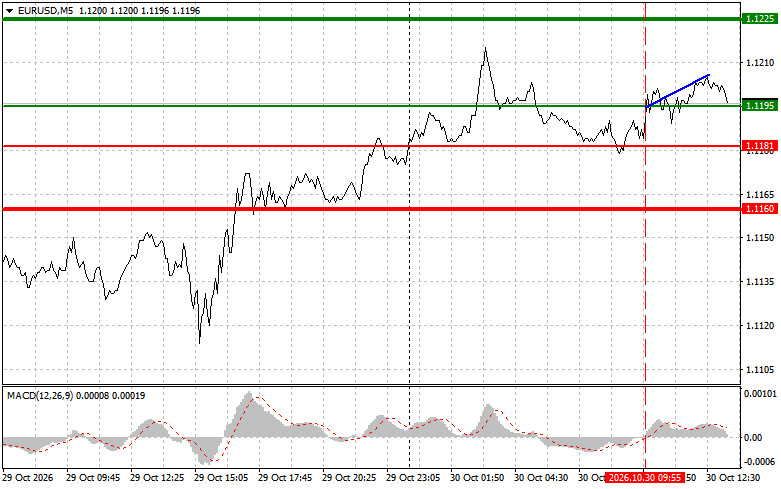
The test of the 1.1195 price level occurred when the MACD indicator had just started moving upward from the zero line, confirming that it was the right point to enter a long position on the euro. However, the pair rose by only 10 points, and that was the end of the move.
The euro advanced following positive economic data, and the most important aspect of this move was not the figures themselves but the picture they painted. Throughout October, the market had been concerned that high energy prices and elevated interest rates would begin to seriously weigh on the European economy, with each new data release testing the strength of these concerns. Today, those fears have eased. Eurozone GDP grew by 0.4% in the third quarter, compared with a forecast of 0.2%, demonstrating greater resilience than expected. The German economy also proved stronger than anticipated, while French prices, by contrast, accelerated more than forecast. This is a combination of factors that the ECB could only partly have hoped for. Economic growth remains resilient, which means the central bank retains the flexibility to continue fighting inflation.
Yesterday, the ECB left interest rates unchanged, and the market took the pause in stride. It still expects the final rate hike of the cycle to take place in December, when new staff projections are released and the deposit rate rises to 2.75%. Today's data have added further support to this scenario.
Next, attention will turn to the October Chicago PMI. The index is expected to decline to 55.8 from 58.8, suggesting a slight cooling in regional business activity. The figure alone is unlikely to change the overall picture, but combined with yesterday's consumer spending data, which showed growth of just 0.5%, it could reinforce the impression that the US economy is being sustained primarily by business investment. Mary Daly will speak afterward, and her previous position is worth keeping in mind. Following yesterday's decision to keep interest rates unchanged and the lack of a clear signal from Warsh regarding December, her comments may offer clues about how the committee views its next move.
As for the intraday strategy, the main focus will be on implementing Scenarios No. 1 and No. 2.
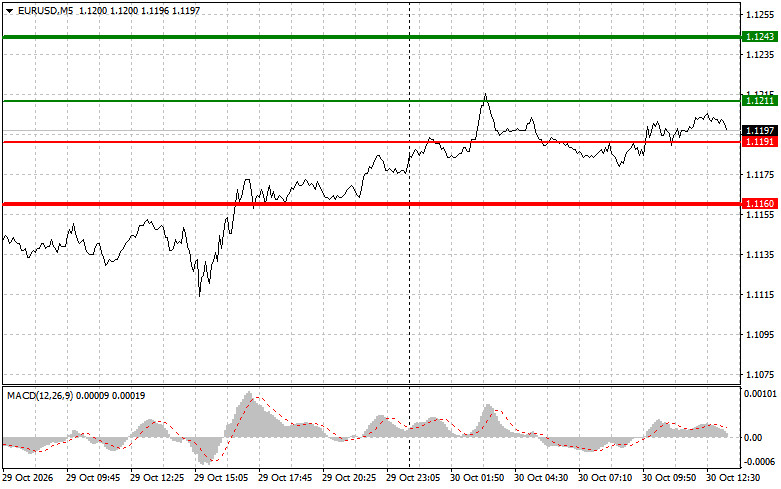
Scenario No. 1: The euro can be bought today when the price reaches the level around 1.1211 (the green line on the chart), with a target of 1.1243. At 1.1243, the plan is to close the position and also open a short position on the euro, targeting a move of 30–35 points from the entry point. The euro may advance today if US economic data are weak. Important! Before buying, make sure that the MACD indicator is above the zero line and has just started rising from it.
Scenario No. 2: The euro can also be bought today if the price tests the 1.1191 level twice consecutively while the MACD indicator is in the oversold zone. This would limit the pair's downward potential and trigger an upward market reversal. The pair could then rise toward the opposite levels of 1.1211 and 1.1243.
Scenario No. 1: The plan is to sell the euro after the price reaches 1.1191 (the red line on the chart). The target will be 1.1160, where the intention is to close the position and immediately open a long position in the opposite direction, targeting a 20–25-point move upward from that level. Selling pressure could return at any time. Important! Before selling, make sure that the MACD indicator is below the zero line and has just started declining from it.
Scenario No. 2: The euro can also be sold today if the price tests the 1.1211 level twice consecutively while the MACD indicator is in the overbought zone. This would limit the pair's upward potential and trigger a downward market reversal. The pair could then decline toward the opposite levels of 1.1191 and 1.1160.
Important. Beginner Forex traders should be very cautious when making decisions about entering the market. Before the release of major fundamental reports, it is best to stay out of the market to avoid exposure to sharp exchange rate fluctuations. If you decide to trade during news releases, always place stop-loss orders to minimize potential losses. Without stop-loss orders, the entire trading account can be depleted very quickly, especially if you do not use proper money management and trade large volumes.
Remember that successful trading requires a clear trading plan, such as the one presented above. Making spontaneous trading decisions based on current market conditions is a fundamentally losing strategy for an intraday trader.

RYCHLÉ ODKAZY
ForexMart is authorized and regulated in various jurisdictions.
(Reg No.23071, IBC 2015) with a registered office at First Floor, SVG Teachers Co-operative Credit Union Limited Uptown Building, Corner of James and Middle Street, Kingstown, Saint Vincent and the Grenadines
Restricted Regions: the United States of America, North Korea, Sudan, Syria and some other regions.


 Kontaktujte nás