Analysis of Trades and Trading Tips for the Euro
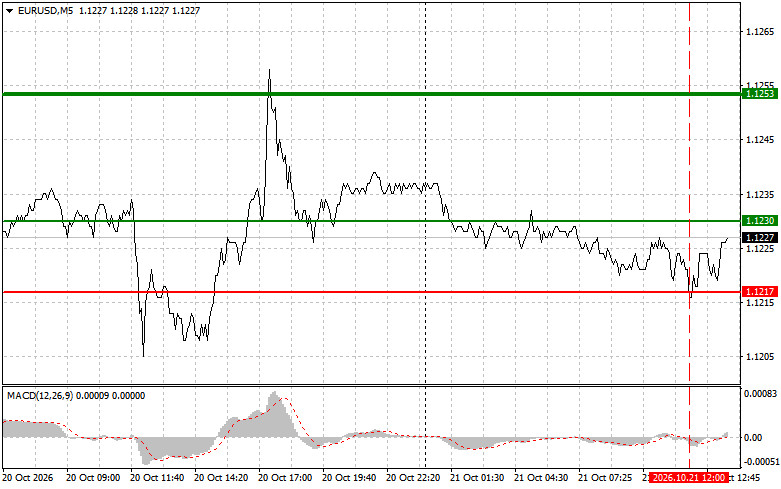
The price test at 1.1217 occurred just as the MACD indicator was beginning to move downward from the zero line, confirming that it was an appropriate entry point for selling the euro. However, the pair did not decline.
The euro failed to extend yesterday's gains following news about the Middle East, as several assessments published by the Bundesbank in the first half of the day disappointed the market. The central bank suggested that the German economy had effectively stagnated in the third quarter, whereas GDP had grown by at least 0.3% in both the first and second quarters. A modest expansion had still been expected in September, so the new assessment was worse than forecast. On the one hand, the German economy has proved more resilient than expected, and the authorities have raised their growth forecast for the current year to 1.3%, more than double the previous estimate. On the other hand, high energy prices continue to constrain economic activity, while investor sentiment in Germany deteriorated on Tuesday for the first time since April. This suggests that the longer the oil shock persists and the more expensive other energy sources become, the greater the risk that indirect effects will push inflation above forecasts. For the ECB and the Bundesbank, this creates a dilemma: the economy has stalled, while price pressures persist.
The second half of the day is expected to be quiet for EUR/USD, as no US economic data are scheduled for release and Federal Reserve officials are not speaking ahead of the policy meeting, as is customary during this period. In the absence of the usual market catalysts, attention will turn to the Middle East. Energy prices are being shaped by developments in the region, and these prices affect bond yields, which in turn influence the dollar's exchange rate against the euro. This is particularly important for the European currency, as high energy prices weigh on the region's economy. The pair will most likely react to news from the region rather than economic data.
As for the intraday strategy, the focus will be on implementing Scenarios #1 and #2.
Scenario #1: Today, the euro can be bought when the price reaches around 1.1230 (the green line on the chart), with a target of 1.1253. At 1.1253, the plan is to close the position and also open a short position on the euro, targeting a move of 30–35 points from the entry point. The euro could rise today if positive news emerges regarding Iran and the United States. Important: Before buying, make sure that the MACD indicator is above the zero line and has only just begun to rise from it.
Scenario #2: The euro can also be bought today if the price tests 1.1215 twice consecutively while the MACD indicator is in the oversold zone. This would limit the pair's downward potential and trigger a reversal to the upside. The pair could then rise toward the opposite levels of 1.1230 and 1.1253.
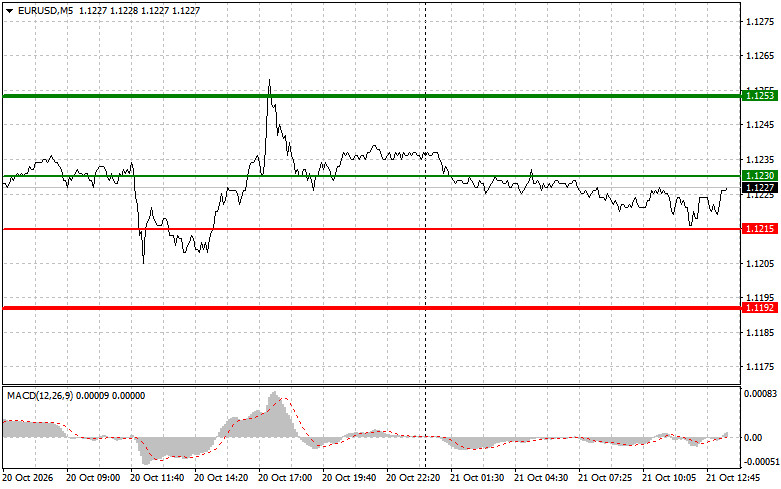
Scenario #1: The euro is expected to be sold after the price reaches 1.1215 (the red line on the chart). The target will be 1.1192, where the plan is to close the short position and immediately open a long position, targeting a rebound of 20–25 points from that level. Selling pressure could return at any time. Important: Before selling, make sure that the MACD indicator is below the zero line and has only just begun to decline from it.
Scenario #2: The euro can also be sold today if the price tests 1.1230 twice consecutively while the MACD indicator is in the overbought zone. This would limit the pair's upward potential and trigger a reversal to the downside. The pair could then decline toward the opposite levels of 1.1215 and 1.1192.
Important. Beginner Forex traders should make entry decisions with great caution. Before the release of major fundamental reports, it is best to stay out of the market to avoid exposure to sharp exchange rate fluctuations. If trading during news releases, always place stop-loss orders to minimize losses. Without stop-loss orders, the entire trading account can be depleted very quickly, especially when risk management rules are not followed and positions are opened with large volumes.
Remember that successful trading requires a clear trading plan, such as the example presented above. Making spontaneous trading decisions based on current market conditions is a fundamentally losing strategy for an intraday trader.

RYCHLÉ ODKAZY
ForexMart is authorized and regulated in various jurisdictions.
(Reg No.23071, IBC 2015) with a registered office at First Floor, SVG Teachers Co-operative Credit Union Limited Uptown Building, Corner of James and Middle Street, Kingstown, Saint Vincent and the Grenadines
Restricted Regions: the United States of America, North Korea, Sudan, Syria and some other regions.


 Kontaktujte nás