
The euro enters the new week in a state of shock. Last week saw a 160-basis-point decline, but it is not the magnitude of the drop that is alarming, but its systemic nature. Market participants sold EUR/USD on four of five days, and judging by Friday's close, they do not intend to stop there. In my recent reviews, we have already examined the reasons for this powerful decline, and it is crucial to understand how much longer the market will sustain these sales. In my opinion, if the issue with the euro had been economic data or the prospects for monetary policy from the European Central Bank and the Federal Reserve, the decline would have lasted at most 2 days. Since we have seen four consecutive days of decline, it indicates something bigger is at play. That something larger can only be geopolitics.
Unfortunately, starting the new week requires us to guess rather than analyze upcoming events. Over the weekend, the situation in the Middle East has not changed. Hostilities have not resumed, and negotiations remain on hold. Donald Trump continues to issue threats against Tehran. On Sunday, the American leader stated that Iran faces very hard times if "they do not agree to a peace agreement." The US President also said it would be beneficial for Iran to reach an agreement with the US, but it is clear that Tehran holds a different view. Therefore, it remains uncertain what the market will face moving forward. If the war resumes, demand for the US currency may rise even further. If the war does not resume (I remind you that my most likely scenario is a prolonged and sluggish conflict without a peace agreement, but also without active hostilities), the US dollar will not be able to maintain its current positive outlook. This factor will account for 80% of the market's movement.
Therefore, in anticipation of the new week, I see little sense in considering economic events. I would only advise paying attention to the April euro area inflation report, which will impact the ECB's decision at the next meeting, and to the business activity indices for May, which have consistently served as leading indicators of economic health. Most economic data will not affect the currency market.
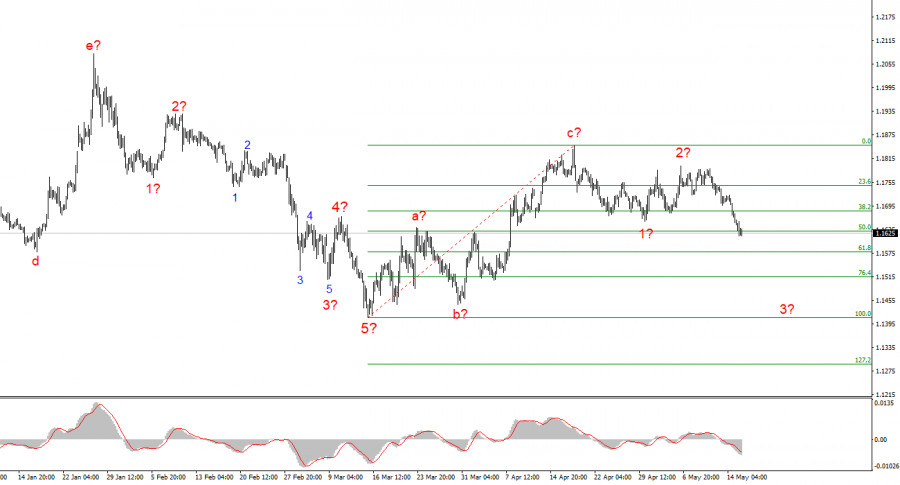
Based on the analysis of EUR/USD, I conclude that the instrument remains within an upward segment of the trend (bottom image) and, in the short term, within a corrective structure. The corrective wave set a-b-c appears to be complete. Therefore, wave 3 in C might have begun, with targets extending to the 14th figure. If the current wave count is correct, the entire wave C could complete its structure much lower than the 14th figure. However, such a scenario would require strong geopolitical support.
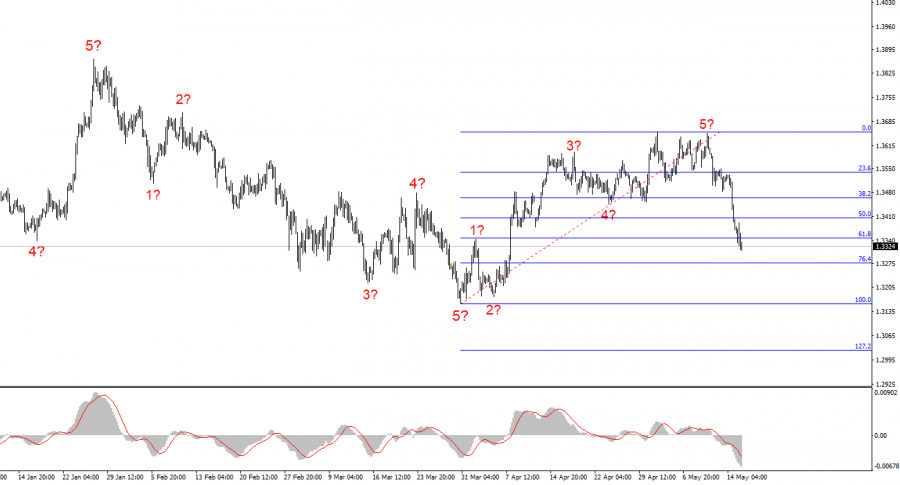
The wave picture for the GBP/USD instrument has become clearer over time. We can now see a distinct upward structure on the charts that is complete. Thus, I expect the formation of a downward wave set that may take on an impulsive nature and coincide with the impulsive structure of the EUR/USD instrument. Consequently, after a 300-point decline, a corrective wave can be anticipated, followed by a new drop to the 30-31 figures. I previously alerted about a new decline for the pound but expected a correction. However, the harsh reality shows that this may manifest as a full-fledged impulsive structure, considering the strength of its first wave.

RYCHLÉ ODKAZY
ForexMart is authorized and regulated in various jurisdictions.
(Reg No.23071, IBC 2015) with a registered office at First Floor, SVG Teachers Co-operative Credit Union Limited Uptown Building, Corner of James and Middle Street, Kingstown, Saint Vincent and the Grenadines
Restricted Regions: the United States of America, North Korea, Sudan, Syria and some other regions.





 Kontaktujte nás