The US midterms are one week away, and markets are holding their breath for developments in the Middle East. The market largely believes that immediately after the congressional elections —
The US midterms are one week away, and markets are holding their breath for developments in the Middle East. The market largely believes that immediately after the congressional elections — regardless of the result — Donald Trump will order a new bombing campaign against Iran; the president himself has repeatedly hinted as much. Of course only the very naive would take all of Trump's words at face value, especially since the White House leader himself does not rule out a deal with Iran. But what deal is possible when talks with Tehran are not even happening? In practice the Middle East conflict has been put on ice until after the elections, which Iran is watching closely because it hopes for a crushing Republican defeat and is doing everything it can to increase that likelihood.
We have already noted the uptick in attacks on commercial vessels in the Strait of Hormuz over the past month. Tehran strikes ships, tankers, and container vessels to keep the strait unsafe and thus keep energy prices high—all intended to maximize US voter dissatisfaction with the president ahead of the midterms. So far Iran has succeeded admirably.
Trump continues to promise a "two-week" military operation in the Middle East for the ninth month running. None of the stated goals have been achieved: Iran still retains nuclear capability and has not accepted concessions or been forced to capitulate under embargoes or strikes. Many experts now say Israel and the US intend strikes on Iran's main nuclear facilities in November. Perhaps. But do we really think Iran does not understand the threat and is not taking countermeasures? Iran now protects its nuclear sites better than it protects the president's residence. The head of state can be hidden; nuclear facilities are harder to conceal. Moreover, enriched uranium—the very material Trump wants destroyed—is almost certainly dispersed across secret sites nationwide. New strikes therefore will likely change little: Iran will preserve its nuclear potential and enrichment capacity.
Trump said recently, "We hit them hard yesterday, and we're going to hit them hard again today." For him the war with Iran is street-fighting rhetoric, not a global conflict that hurts the whole world. That tells you all you need to know about the US president's mindset, which governs the conflict's fate. Essentially Trump has been digging his political grave for two years, but the funeral will not happen. Whatever the midterms' outcome, Democrats lack the votes to impeach him. The US president cannot serve more than two terms, so in two years Trump will leave office in any case. Practically, he can do whatever he wants now without fearing for his political career.
Other articles to read:
Overview for EUR/USD. October 27: USD to rise only in one case
Overview for GBP/USD. October 27. Pullback or new USD trend?
Trading recommendations and trade analysis of EUR/USD, Oct 27
Trading recommendations and trade analysis of GBP/USD, Oct 27
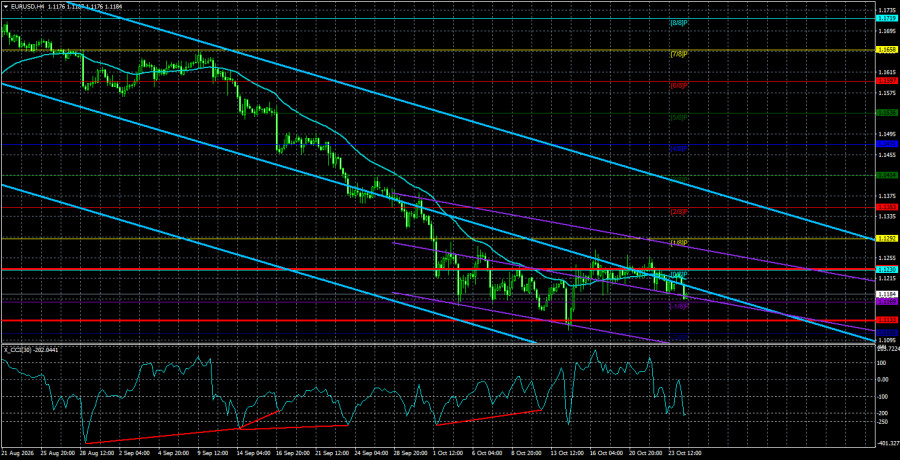
Trading recommendations for EUR/USD:
EUR/USD continues to move lower, but we still view the decline as a correction ahead of a new uptrend. The global fundamental backdrop for the dollar remains unfavorable, yet in 2026 geopolitics first and then the Fed's hawkish stance provided strong support for the US currency. While price trades below the moving average, consider shorts with targets at 1.1133 and 1.1108. Above the moving average, longs are relevant with targets at 1.1292 and 1.1353.
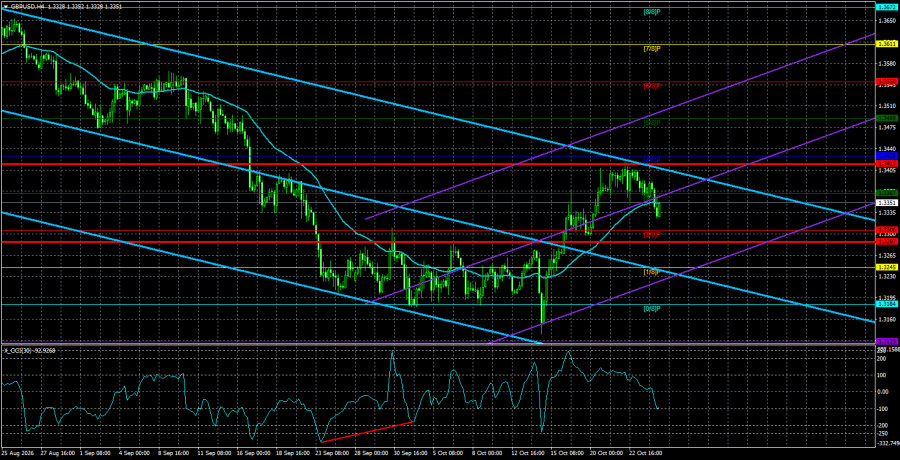
Trading recommendations for GBP/USD:
GBP/USD has begun an upward move that could develop into a lasting trend. Donald Trump's policies will continue to weigh on the US economy, so we do not expect long-term dollar weakness. 2026 has so far been positive for the dollar because geopolitics and inflation have driven capital to safety and pushed the Fed back toward tightening. However, on the weekly timeframe, the pair remains rangebound between 1.3150 and 1.3780 within a four-year uptrend, which supports a medium-term bullish case for sterling. Consider longs with targets at 1.3415 and 1.3428 if the price trades above the moving average. Price below the moving average makes downside trades viable with targets at 1.3306 and 1.3287.
Explanations for the illustrations:
Regression channels help identify the current trend. If both channels point the same way, the trend is strong.
The moving average (settings 20, 0, smoothed) defines the short-term tendency and the direction to trade.
Murray levels are target zones for moves and corrections.
Volatility bands (red lines) mark the likely price channel for the next 24 hours based on current volatility.
The CCI indicator entering oversold (below -250) or overbought (above +250) territory signals a likely trend reversal.
ForexMart is authorized and regulated in various jurisdictions.
(Reg No.23071, IBC 2015) with a registered office at First Floor, SVG Teachers Co-operative Credit Union Limited Uptown Building, Corner of James and Middle Street, Kingstown, Saint Vincent and the Grenadines
Restricted Regions: the United States of America, North Korea, Sudan, Syria and some other regions.


 আমাদের সাথে যোগাযোগ করুন