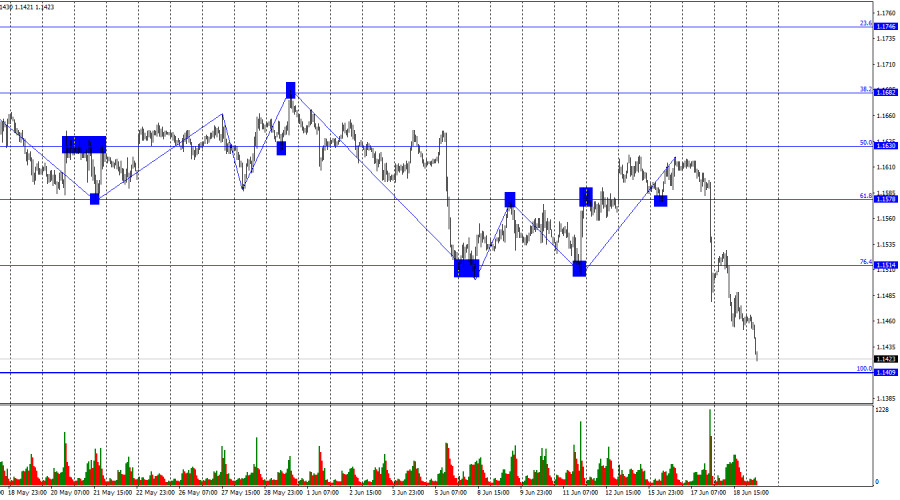
The EUR/USD pair continued to decline on Thursday after consolidating below the 76.4% Fibonacci retracement level at 1.1514, moving toward the 100.0% corrective level at 1.1409. A rebound from the 1.1409 level would favor the euro and allow for a moderate recovery toward 1.1514. Consolidation below 1.1409 would increase the likelihood of a continued decline toward the next Fibonacci level of 127.2% at 1.1291.
The wave pattern on the hourly chart has changed once again. The last completed upward wave broke above the previous peak, while the new downward wave also broke below the previous low. As a result, the trend has once again turned bearish. Geopolitical conditions have improved significantly in recent weeks, but the Federal Reserve has triggered a new wave of bearish pressure. A full-scale bearish move would require additional factors, which I do not currently see, but bulls are offering virtually no resistance at the moment.
There were very few important events or news releases on Thursday. The euro spent most of the day declining, although it would be more accurate to say that the U.S. dollar strengthened throughout the day. The pair continued to fall overnight into Friday, indicating persistent bearish pressure and the complete absence of bullish activity in the market. What could be driving this move? In my view, it is not solely the outcome of the Federal Reserve meeting. Kevin Warsh and his colleagues did much to support the dollar, but I cannot say that the possibility of tighter monetary policy in the future is sufficient justification for a 180-point rally in the U.S. currency. It feels as though traders are either missing part of the picture, or bears had been preparing for this move for a long time and simply used the FOMC meeting as a catalyst. It should be recalled that the Federal Reserve left monetary policy unchanged at its June meeting, and only half of the FOMC members projected one additional rate hike before the end of the year. In my opinion, the regulator's hawkish stance is evident, but it is not strong enough to justify such an aggressive rally in the dollar. Nevertheless, traders can currently rely on technical analysis and key levels, as price action remains firmly one-directional. After all, what could be better for a trader than a well-defined trend?
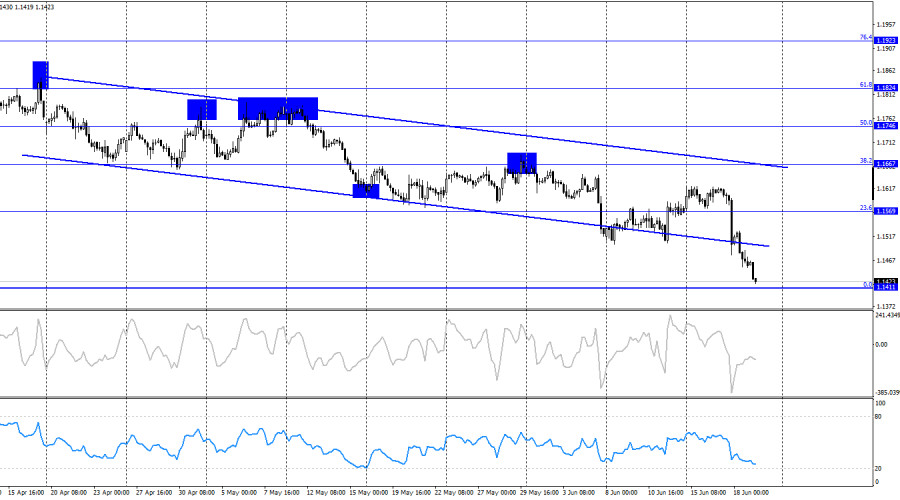
On the 4-hour chart, the pair continues to decline toward the 0.0% Fibonacci retracement level at 1.1411. A rebound from this level would support the euro and allow for a moderate recovery toward the 23.6% Fibonacci retracement level at 1.1569. Consolidation below 1.1411 would increase the probability of a further decline. No emerging divergences are currently observed on any indicator.
Commitments of Traders (COT) Report:
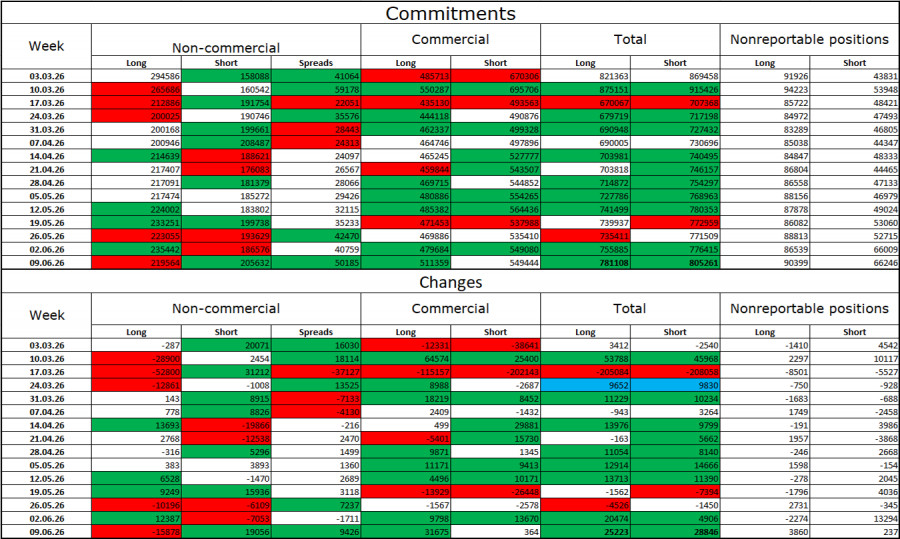
During the latest reporting week, professional traders closed 15,878 long positions and opened 19,056 short positions. Over the seven-week period in February and March, the bulls' overwhelming advantage disappeared due to the conflict in Iran. During the past eleven weeks, the situation has stabilized amid a pause in hostilities in the Middle East, and bulls have once again regained the upper hand. The total number of long positions held by speculators now stands at 219,000, while short positions amount to 205,000.
Overall, large institutional traders continue to favor the euro over the long term. Naturally, global developments of various kinds—which have been plentiful in recent years—continue to influence investor sentiment. In particular, market attention remains focused on the Middle East, where the conflict has been paused rather than resolved. Therefore, in the near term, the direction of the euro and the U.S. dollar will depend less on Federal Reserve or ECB monetary policy and economic data, and more on developments in Iran.
U.S. and Eurozone Economic Calendar:
The June 19 economic calendar contains no notable events. Therefore, the economic backdrop is unlikely to have any impact on market sentiment on Friday.
EUR/USD Forecast and Trading Tips:
Long positions may be considered today if the pair rebounds from the 1.1409 level on the hourly chart, with a target at 1.1514. Short positions could previously have been opened following a close below 1.1578 and below 1.1514, targeting 1.1409. That target has nearly been reached. New short positions may be considered after consolidation below 1.1409, with a target at 1.1291.
Fibonacci grids are plotted from 1.1409 to 1.1850 on the hourly chart and from 1.2081 to 1.1411 on the 4-hour chart.
ForexMart is authorized and regulated in various jurisdictions.
(Reg No.23071, IBC 2015) with a registered office at First Floor, SVG Teachers Co-operative Credit Union Limited Uptown Building, Corner of James and Middle Street, Kingstown, Saint Vincent and the Grenadines
Restricted Regions: the United States of America, North Korea, Sudan, Syria and some other regions.





 আমাদের সাথে যোগাযোগ করুন